
Antenna Cables
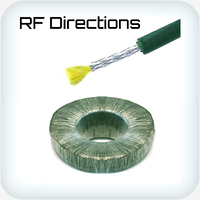
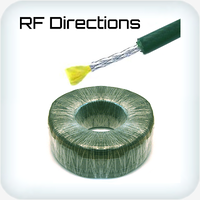
RF Directions kevlar antenna elements offer significant advantages over hard drawn copper wire antenna construction materials. The high 75kg tensile strength and super light 15g per metre kevlar antenna elements provide long term, low maintenance and reliable service for dipole, cubical quad, long wire and portable antennae construction components. Nine cores of 1500D are at the centre of the element wire and support cables. The conductor consists of 16 x 3/012mm² tinned copper braid with a UV stabilised olive green jacket with a 3mm outside diameter.
Engineering Advantages & Practical Applications - Frequently Asked Questions
.png)
.png)
.png)
.png)
Engineering Advantages & Practical Applications
Advanced Kevlar Core Stability
At the center of each wire element and support cable are nine independent cores of 1500D Kevlar. This ultra-high tensile strength core bears the entire mechanical load of the span, entirely isolating the electrical conductor from physical stress. Unlike standard hard-drawn copper, which permanently stretches and alters antenna resonant frequencies over time, this zero-stretch aramid core preserves the original physical tuning of the antenna across years of heavy wind and ice loading.
Optimised Lightweight Conductor Design
Weighing a mere 15g per metre, these elements significantly reduce the static load placed on masts, portable poles, trees, and center insulators. The conductor layer consists of a robust braid featuring sixteen groups of three 0.12mm² tinned copper strands. This braided configuration maximises surface area to optimise radio frequency skin depth conductivity, while the protective tin coating eliminates underlying copper oxidisation and galvanic degradation at connection points.
Versatile Aerial Configuration
The lightweight profile, high 75kg breaking strain, and compact 3mm outside diameter make this high-performance wire highly adaptable for fixed station and tactical field builds. It serves as an ideal structural component for building permanent multi-band dipoles, directional cubical quads, extensive long-wire arrays, and rapid-deploy portable antennas. The UV-stabilised olive green jacket ensures excellent physical stealth and exceptional resistance to intense sunlight exposure.
Frequently Asked Questions
How does this element prevent antenna detuning compared to hard-drawn copper?
Hard-drawn copper wire naturally stretches under its own weight, wind loads, or ice accumulation. This physical elongation shifts the resonant frequency of dipoles and wire arrays upward or downward over time. RF Directions elements utilise a nine-core 1500D Kevlar center that does not stretch under load, ensuring the physical length and tuned standing wave ratio of the antenna remain perfectly stable indefinitely.
What are the conductivity benefits of the 16 x 3/0.12mm² braided configuration?
Radio frequency currents travel primarily along the outer surface of a conductor due to the skin effect. By utilising a flexible braid composed of forty-eight individual tinned copper strands rather than a single solid conductor, the total effective surface area is greatly increased. This design maintains low RF resistance, minimises signal loss, and offers excellent structural flexibility without risking work-hardening failures.
Can this wire be used effectively for long-span wire antennas or stealth applications?
Yes. The 75kg tensile strength allows for long, unsupported horizontal runs without excessive sag, making it excellent for long-wire installations. Additionally, the ultra-thin 3mm profile combined with the non-reflective, UV-stabilised olive green jacket ensures the wire blends naturally into background foliage, making it highly suitable for restricted suburban installations or discreet tactical operations.
RED2GO Helpful Link - The Central California DX Club Comprehensive Wire Antenna Calculator